Sexiest bikers alive.

I’ve always fancied myself looking stellar on a motorbike.

I regularly imagine myself sitting astride a Harley Davidson looking very, very sexy. In these dreams I race through town, leaning into corners and overtaking Audis. When I take my helmet off I shake my hair out quite seductively as traffic stops around me. Sometimes there are bad accidents, but I cannot help that. I’m usually blonde in these dreams, too, and wearing some tight leather outfit. My breasts are bigger, obviously.

Of course, Asia is the perfect place to turn these dreams into a freshly-minted reality.

The beaches in the south of Cambodia, around Sihanoukville especially, provide a spanking location for the transformation from daggy backpacker to sexy biker. A local election also meant a 48-hour drinking ban, so the timing was nice, too.

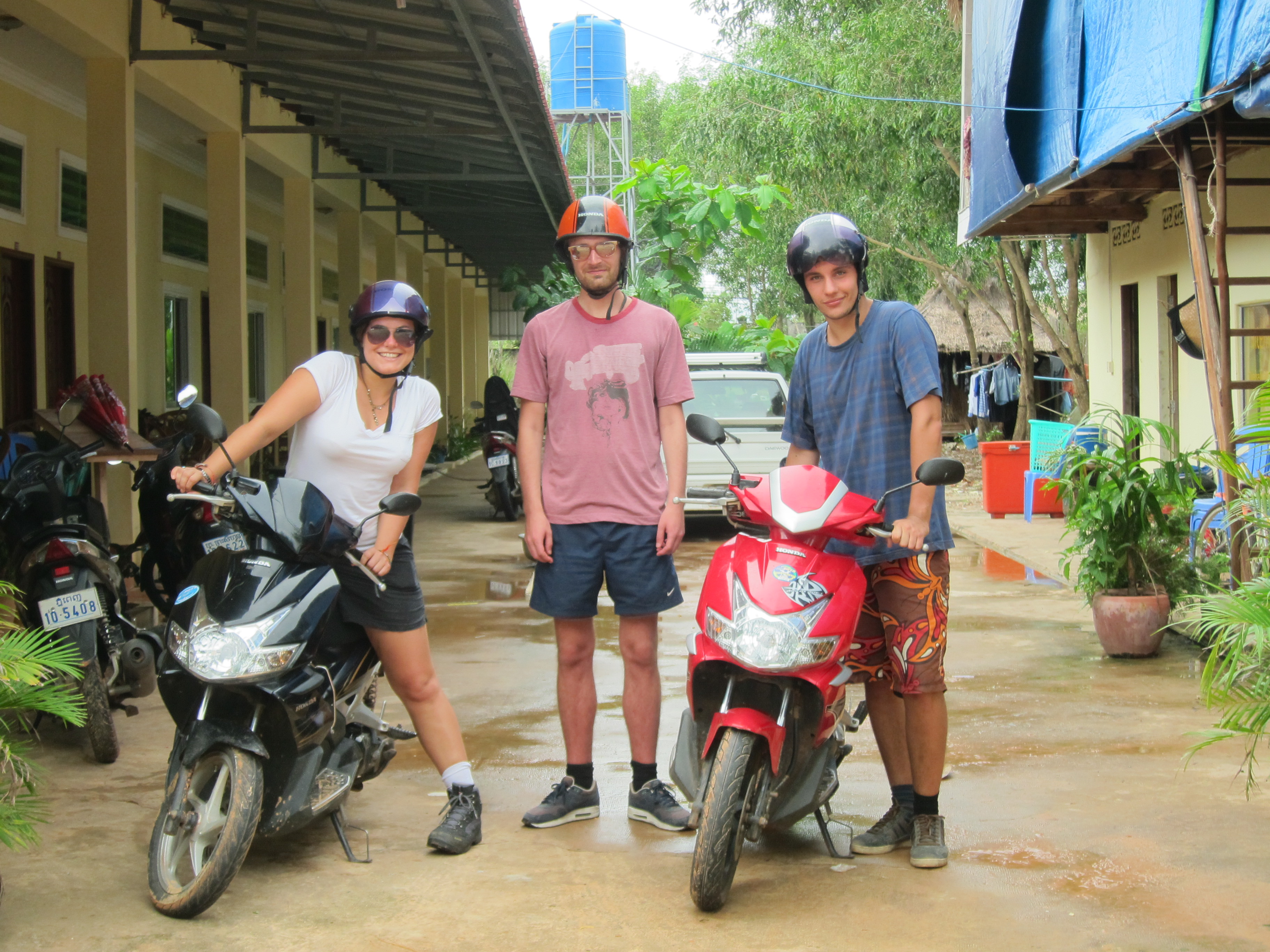
A $6-a-day 125cc scooter and a stripey helmet completed an already-amazing set of circumstances.

The Swedes planned to rev the engines early in the morning, possibly even catching a sunrise. At 2pm we set off, dust flying behind us, loving the freedom our new wheels provided.

We’d decided that it would be more adventurous and spontaneous if we avoided maps and any comprehensive advice regarding directions.  We had no wanky getting-lost-is-the-best-way-to-find-yourself-ambitions, but were keen on finding something interesting and unplanned.

However, with a long-armed navigator pointing out the best directions from the back of the second scooter, we failed to lose the way. He could spot a bar flouting the beer-ban from miles away.

We found a plethora of stunning tropical beaches as we hugged the coastline, palm trees lining the turquoise water. Some were packed with tourists and aggressive bracelet-vending touts while others just had a handful of local tourists peacefully building sandcastles. Others were dominated by imposing resorts that restricted access to the paradise on their doorstep. Clearly, Cambodia’s beaches are a hot-spot on the cusp of hitting the big time. For now, they’re still relatively untouched.

We skidded out of the soft sand, watching the landscape change as we ventured away from the peaceful Otres beach we’d called home for a few days.

We tapped into a bit of culture, too, at a few local villages. The diversity of wealth astounded me. We’d pass roadside slums just metres from larger houses with manicured gardens, and then modest villages showed us the farming way.

I loved waving at the cute little kids as they ran out smiling and yelling hello. It is every biker’s dream to have some groupies.

There were monkeys, too, of course. We came across a bunch of the cheeky creatures after testing out our skills on some wicked bends. A few were casually tucking into bright yellow bananas, others were wrestling on the road, oblivious to the passing trucks and scooters. One of the more vain in the tribe had perched himself (or herself, I guess) on a stationary bike and was devoting some serious time to gazing into their own eyes in the mirror. I think the Swedes were doing a fair bit of that on their bike, too.

Perhaps the best sensation was the freedom to go wherever we wanted, pointing the handlebars down dirt roads and highways at will. After months of cramped, leaking buses and ridiculously comfortable trains, it was a treat to be the master of the road, owning the bitumen, following the random gestures of the long-armed Swede.

Of course, the roads were perilous in places, further enhancing our exhilaration. Semi-trailers would scream up behind, honking at us as if we were flies the driver craved to swat away. Occasionally a normal car would try to run us off the road, honking viciously as if we’d stolen their last portion of amok and rice. Interestingly, all of the cars drove around with their boot’s up; air conditioning, perhaps?

One thing is certain, none of the other motorists looked as cool as the serious Aussie/Swedish biker crew. And, of course, when we got back I shook my hair out of my helmet very sensuously.

I’m told I looked just like a brunette version of Claudia Schiffer. Or, maybe some dreams will never cut it in the real world.


Angkor Wat the?

It was a cheap calendar that first sparked my interest in Cambodia’s famous ruins. I’d prefer to be harbouring a deep-seated Khmer history obsession, but the calendar offers a more simple brand of inspiration.

So, from June last year, after a month staring at spindly plants entwined with ancient stones, I was aching to see the Angkor temples in Cambodia. Of course, I had no idea what the temples represented, or if they were even temples at all. In fact, I had no idea what Angkor meant and only a hazy idea of where Cambodia was.

But, my love for pretty things prevailed and today I conquered the Angkor dream.

Along my travels I had collected a few meagre facts about the place from backpackers heading in the opposite direction. It’s not just one temple, as I’d ignorantly assumed, but a collection of temples spread out over about 140 square kilometres. Clearly, this was going to be a hectic day trip.

Another traveler informed me that it’s not essential to see all of the ruins, although three-day tickets are available. The idea of spending three days strolling around mossy, tree-infested stones in severe tropical heat appealed to me as much as one of those revolting fish massages where the fish eat your dead skin.

One day would be enough, I thought, planning to treat the temples like a cheese platter.

With this armory of facts my two Swedish pals and I set the alarm for 4.40am, our dedication to seeing the sunrise as firm as a bitter papaya.

The sunrise, luckily, was stunning. The colours were superb with the ruins basking in the sun’s morning glow. A few pigeons flew noisily around the tops of the temples, greeting us.

The place had an eerie quality about it in the dawn haze. I got the feeling some nice stuff had happened at the place, which was refreshing after visiting the confronting and poignant war museum yesterday.

Once we were at the temple, however, the question we’d been avoiding reared it’s complex head. “What was this place, anyway,” someone asked.

We sat around, struggling to rouse our minds with a strong coffee, watching the colours change, toying with the question.

We pooled our knowledge of the ruins, discovering that construction began in the ninth century and continued for a few centuries after that.

After we exhausted our communal supply of Angkor facts, we began congecturing. Perhaps it was palace for the King, after all it has a moat around it and I could see some horses trotting around the paddocks. Or perhaps it was just a place for the village meetings?

In our confusion, one of the ubiquitous hawkers grabbed my tired mind.

“You want book, lady,” he asked me. “Do I,” I wondered. I nodded, then shook my head, then looked away, then said hello, then asked the price, then said no again and looked away again.

“You’re giving this guy some weird signals,” one of the Swedes pointed out, rather astutely.

I mucked around with the poor sucker for a little longer before settling on $5, which I thought was a good deal. He’d started at $28. But, alas, the next guy offered me the same book for $1. Oops. And, it was far too wordy to figure out what had happened at Angkor Wat, so we decided it’d be best to stroll around, leisurely, making up different uses for the stunning buildings.

Perhaps it had been a paintball field? Or a home for pretty girls to learn some manners?

The ambience of the place struck me, with Hindu-type music playing in the background and the smell of incense haunting our noses. The carvings which were etched upon most of the walls, were incredibly comprehensive, detailing all sorts of animals and deities going about their business.

I could not help imagining the place in all of its splendour, or thinking of the guys who must have toiled for years to make the incredible stones.

At Angkor Thom, the next temple on the list, my jaw dropped as I saw the huge faces that had been molded into the stones far above our heads. The profiles were impressively accurate. It was like a Magic Eye puzzle, seeing the stones and then the faces and then just stones again.

Our expert knowledge came to the fore again as we looked at each other with blank faces, wondering where the temple was with all the trees growing around the rocks. That was the original calendar image that sent me into a fever of wonderlust last June, so I thought I should pursue that.

The book paid for itself here, and we bargained with our surly tuk-tuk driver to take us to Ta Phrom.

For an extra $5 he took us the extra one kilometre. We rode along in our motorcycle-drawn chariot, checking out some smaller ruins and indulging in fantasies of ancient royalty and chauffeurs.

Ta Phrom did not disappoint. The silk-cotton trees (you can see the book coming handy again) had captured the old rocks and twisted them to their will, creating a sense of the time that had passed. The carvings stood proud against the branches, defiant.

I ambled around those ruins like Alice in the rabbit hole, overawed by their size and age. It was a powerful place, for me.

As we debriefed at the cafe, indulging in some cheesy snacks and wondering how we’d been awake for almost six hours when it was only 11am, we shared our impressions of the morning.

“It’s mysterious,” one of my pals pointed out, redundantly. “That’s all I know about it, that it’s mysterious.”

“It’s… ahh… yeah… they were good, I guess,” the other noted.

I’ll put their enthusiasm levels down to tiredness and a bad bout of diarrhoea one of them is suffering from.

I reckon they were bloody fantastic, the best ruins I have ever seen and definitely a highlight of my travels so far.

Clearly, favouring calendars over sleep-inducing history books is not a disadvantage.

4000 reasons to love a hammock, the 4000 Islands, Laos.

Sometimes it’s the scenery. Sometimes it is the local people or the food. It may even be the tourists or the mosquito population that determines how charming a place is.
I recently touched upon a new way to measure a destination’s performance. On Don Det, one of the stunning 4000 Islands that dot the Mekong in southern Laos, my tolerance for late-arriving food affirmed my love of the place.
Here, I would sit in the restaurants with my companions, hunger eating away at my sanity, but barely caring. We would casually playing cards and take bets on how much longer our food could possibly take to whip up.
“How far do you think it is from the top of that tree to the water,” one of my companions asked one morning during our patient wait.
It’s a ridiculous question, unanswerable and largely pointless, but we’d sit there, pushing away thoughts of an omlette and focusing on life’s minor trivialities.
Other questions, sush as “what’s your favourite hammock position” and ranking our favourite fruits, helped the time pass very pleasantly.
In Laos, nothing much happens in a hurry. Sometimes, especially in the midday heat, nothing at all happens and buying a packet of Pringles becomes a cloak and dagger mission.
On Don Det, this laid-back approach refreshed me on the half-way point of my travels. It is easy to assume that with no work, just play, play and more play, that traveling is a leisure pursuit. I prefer to think of it as an endurance mission, fitting in temple visits around dysentry and a rampant party scene, with sleeping only happening as an afterthought. It’s exhilirating.
But, after a hectic few days in the party mecca of south east Asia, Vang Vieng, where a simple activity such as floating down a slow-flowing river in a rubber tube becomes a tarzan-infused, booze-fuelled, best-day-of-your-life fiesta; I was ready to switch my dancing shoes for a bikini.
We arrived on Don Det, scouring the bungalows for the best hammocks. Mrs Daeng, our charming hostess, who had a glint in her eye that’d rival the hungriest of foxes, welcomed us into her pad. We were the only guests for the majority of the five-day bliss-fest and she lavished attention upon us as if we were deities, returning from the dead, fixing everything we broke and taking trips to the mainland for essential supplies, such as baguettes and BeerLao.
Most days would begin with a journey from the bed to the hammock, a few steps that could feel like a marathon at times. Breakfast would be ordered as we gazed out over the Mekong, oriental dreams afoot. In the interminable wait between ordering and receiving our food we’d play cards, constantly fantasising about food. Occasionally breakfast would not finish until well past midday and the daily activities would not start until the early evening. Quickly, we discovered island time.
Another favourite acivity was watching the local kids swim in the river. From our hammocks, or the restaurant terrace, we’d watch them climbing along a precariously-placed palm tree and jumping off the top into the river. Their wrestling matches easily replaced the desire to read a book.
Occasionally we’d join them, pushing them into the water and battling against the ferocious current.
Of course, there were the daily activities that self-respecting tourists should not miss. It’s essential not to be seen as a lazy backpacker. To relieve the hammock-guilt we would ride around the island on bikes, finding new restaurants and trying different flavours of fruit shake. One day, we rented tyre tubes and floated down the river in the monsoon rains. In a fit of exuberance, we even dedicated one day to a lengthy stroll to visit a spectacular waterfall.
Once these pursuits were tied up, the hammock-therapy continued.
My good-luck fairy paid me a wee visit, timing my stay with the rocket festival. At 6 in the morning the drums would start humming as processions of locals drinking Lao Lao made music and danced in the streets. Rockets shot across the sky as a gesture to the Gods, praying for a good harvest.
That’s my kinda religion, I thought one day as I sat in an internet cafe with firecrackers being thrown around as if they were candy at a circus.
I intended to stay just three or four nights on Don Det, but in another sign of a place’s charm, I overstayed, dragging myself off after five nights, reluctantly.
As we sat in the dugout canoe, heading back to the mainland and back to the temple-party merry-go-round I felt like a different person. The hammocks were an instant balm to my slight travel fatigue.
Most importantly, however, I have been charmed by the Laos islands, and it’s always nice to find a new place to love.

Leeches and a starry, starry, starry night.

I arrived at midday in Luang Namtha in northern Laos with a life-altering mission: to find some bloody friends.

A shower, hair-wash and book-swap was also on the agenda, but after three days on the road, alone, there was nothing more important than bursting my bubble of loneliness and creating a new opportunity for myself.

I saw a fluro green shirt with pink writing and ran for it, knowing that no self-respecting local would be wearing something so ridiculous as a shirt that shouted Full Moon Party to the world, but this was my kinda person. And Tomas insists it was laundry day.

As I approached the French-Canadians in a brimming tuk-tuk, I did not even bother to hide the desperation in my eyes. “Do you mind if I join you,” I panted at them, pining for some company. They tactfully ignored my pleading tone and, thinking that perhaps I’d be so grateful that I’d buy them dinner, they welcomed me into the fold.

At the travel agency I met the Scots and the five of us booked a two-day jungle trek. How’s that for committment, eh.

With a huge sigh of relief I cast aside my solitaire-playing days for a while. Then, the luck tide bought a fresh wave of recruits; five became nine and we set off for the hills.

We’d called ourselves the Awesomes, and I wondered if they’d live up to my lofty expectations after trekking with The Best Group in China. Mostly, I wondered if I’d ever begin to call groups something original.

Our launch point was a picturesque village, complete with a bamboo suspension bridge, leaf-roofed huts, gap-tooth locals and some smiling kids splashing in the river. I wondered what they thought of our bunch, tromping through their space with our colourful backpacks and clumpy shoes. Hopefully, we are not too invasive.

The first hill was always going to be a killer. Pon, our cheeky guide, told us the trek was easy-to-moderate, but if it was raining it malevolently changed to moderate-to-difficult. I reckon it’d be death-defying in the rain, as the mud and leaves were already mincing beneath our steps. Watching the fellow trekkers slip was better than the circus.

We trudged steadily up, brushing vines out of our faces and basking in the tropical scenery. The heat and rampant humidity adds an extra dimension. I have only ever trekked through mountains, and in refreshing altitude climates, but jungle treks, I soon found out, are a different brand of walk. As we huffed and puffed up the hill like a pack of recovering asthmatics, the sweat dripped from my eyebrows. All of our clothes looked as if they’d been taken out of the washing machine long before the spin cycle kicked in.

The scenery made up for it, however, and I had plenty of new mates to grill.

My favourite part of any day, and this is even more profound during a day of walking, is meal time. Banana leaves were fetched from the forest and spread across a rickety bamboo table. Vegetable curries were poured onto the leaves and we received a parcel of sticky rice each. Eating with hands was compulsary. I was in heaven.

But, the peace was short-lived. We encountered our first leeches as we strolled along the ridge, just a stone’s throw from the luchspot. The girls were screaming and desperately trying to pick them off their shoes. I had my first bite from an over-achieving thirsty sucker.

Then, my rampant dysentry reared its runny head.

A few moments after I re-joined the group I was the first to muddy the seat of my pants. I also managed to snag a pretty bruise on my inner arm after I caught a branch when I fell. Soon, we were all hitting the deck like a toddler trying to shuffle a pack of cards.

We stopped briefly at a stream for one of the guides to sharpen his knife on a stone. I’m sure it was just for dinner, but the thought of the local tigers kept my mind amused for a while.

Here is where the real trouble started. Pon, in an innocent-sounding, nonchalant voice tells us that the section ahead has many leeches. We’d been battling the bloodthirsty insects for some time already and were decidedly concerned by this relevation.

The avenue of leeches was torture, that we had paid for.

The slimy suckers littered the ground, as prevalent as the rotting leaves. Their heads reared up like a herd of angry stallions, desperately seeking some sweet, sweet tourist blood. We were constantly bashing them with sticks to get them off our shoes. I prefered a quick flicking action which I perfected as a kid on long school-bus rides with my brother. Back then, we’d flick each other’s foreheads until the other could handle it no longer. I never thought that sadistic game would come in useful, but I never anticipated the Laotian leeches to be so clever.

In fact, it was comical at times. The group would run through the jungle, as quick as possible, and then stop for a brief bashing to get the leeches off the shoes. Estonian, French, Austrian, Spanish and English swear words were flying around the bush like out-of-control frizbees. For almost 40 minutes the scream, run, scream, bash, swear, run, scream, swear, bash, scream, run routine was adhered to with Japanese precision.

Time flew by.

We stopped in the searing sun, in relative safety, to lick our wounds, calm our pulses and check inside our shoes. I screamed like a banshee when I saw two inside my trusty hiking boots; I was so disappointed in my boots.

Later on, as we chuckled about the episode, I felt something biting my inner thigh. Inhibitions were left on the track as I plunged my hand in my pants and pulled on a filthy leech. More screaming ensued as I got the sucker out, but the real trauma was not in the bite, it was the fear of a leech getting any closer to my panty line.

Accordingly, my hand stayed in my pants for the rest of the walk; paranoia, check.

It had been a torturous day, but arriving at a local village five hours from any civilisation put things sharply into perspective.

Pigs, ducks, chickens, dogs and cows of all ages wandered around the thatched huts. It was an idyllic setting by the river. After a quick swim, we played some games with the beautiful kids, a few of the crew pulling out enormous energy to teach the locals stuck in the mud and other running and tagging games. Their smiles were heart-warming, but I was touched by the kids’ threadbare clothes. The village was pleasant in so many ways, subsistence farming and kids seemingly enjoying a childhood, but I could not ignore the poverty, and served mysef a healthy slice of Western guilt.

Dinner was a feast. Tofu and tomato curry, beef curry and pumpkin soup satisfied our hike-induced appetites. I adore the guilt-free eating that comes with hiking.

The local whiskey, Lao Lao, was passed around the table. “Bottoms up,” Pon commanded us. Of course, we obliged.

The laughter at the table soon turned to talk of the stars. We were excited to be in the country with a clear sky and soon made ourselves a nest near the fire to observe the sky.

Our collective quest to spot a shooting star was disrupted by some pesky night-time playthings – the fireflys.

After a flash of light the group would yell out, collectively, in excitement. Moments later the flash would appear a few beats to the left and we’d simultaneously emit a loud sigh before we laughed at the easy error.

“If it changes direction, it’s not a shooting star,” the helpful Scotsman pointed out for the less astronomically-minded in the group.

The fireflys contibued to wink at us as we searched the solar system for movement. A few satellites kept us entertained as the group gradually peeled off to bed.

By 9pm a beautiful Bolivian lady and the fiesty Austrian remained on the blanket with me. We huddled together with a few beers and plenty of tales to share. Finding two solo female travelers provided perfect like-mindedness. Our laughter echoed off the trees as we told tales from home and abroad, still searching for shooting stars.

The fireflys were beautiful and provided endless entertainment for us star-gazers. At one point the Austrian lept onto her elbows, exclaiming “I hate the fucking fireflys. They’re so fucking mean!” And we laughed some more.

I believe we saw one real shooting star that night, but the real joy for me was the sense of community I felt with people I had met just hours before. The Awesomes were vastly different from the Best Group, but they were the balm that shooed my loneliness out the door, replacing it with new mates and memories of a night by a creek, with some insects, a dash of local whiskey and a sky full of stars to wish upon in some little village in northern Laos.

How I love to ride the rail.

The rocking movement of trains produces an exciting array of sensations in passengers.
I have heard from some of my more perverted friends that riding the rail stimulates them sexually. Others say hanging about on the bohemoth vehicles makes them sleepy. For me, when I climb aboard a train I feel immediately at peace with the world.
So, when I needed to calm my anxious nerves and realise the joys of traveling alone again, 18 hours on the railway seemed extraordinarily appealing . The thought of getting a few hands of solitaire in made me quiver with excitement, like a coffee addict getting a whiff of espresso. Chendgu to Xian in northern centreal China would be the perfect backdrop for some train meditation.
Preparation for such a journey, luckily for me, is fairly straightforward. I purchased a few beers, a box of instant noodles (super tasty in China, I even drink the oily broth), a large bag of sunflower seeds (these are amazingly popular here and sold unshelled, you crack them in your mouth and spit out the shell, swallowing the pip; it kills endless amounts of time), toilet paper, a generous handful of dried sweet potato and a bag of marinated tofu to add to the noodles. A large bottle of water usually comes in handy too. My favourite part about these preparations is that if you forget anything a cart on the train will help you out. They even have a proper restaurant.
It’s best to arrive early for the trains.
I love watching the sea of humanity outside the station. You can catch the smart-looking businessmen with their fancy shoes sitting beside boisterous family groups with an array of stripey luggage bags or next to grubby-looking beggars with their children sleeping on dirty rags. The contrasts and sheer amount of people in these places always ignites my contemplative mind, which is perfect for the journey ahead.
Train travel is exceedingly popular in China and you can get almost anywhere by rail. The stations fit more people in the forecourt than your most popular amusement park, which is only natural as a ride on one of China’s famous trains definitely rivals anything you’d find at Luna Park.
Yesterday, as I sat in the waiting room, on the floor as the seats were mostly taken up by greedy fat men napping, I laid out my first game of solitaire with relish. I could sense about 167 pairs of eyes on me, the only Western girl in the establishment, and a loner at that. I’m sure they were thinking I was weird and uncool being along, which is cool, because I’m not so taken with their penchant for eating turtles. Still, we exist together easily.
Then, an excited Chinese girl came and sat beside me, eager, as they always are, for a photo together. As usual, I was touched by her innocence and enthusiasm.
We sat together for about 20 minutes, understanding little of what the other said. It was the blind leading the blind, both apologising for our language shortcomings.
She even called her English-speaking brother on her cell, so he could tell me how pleased she was to meet me.
It still blows my mind that such short, chance encounters can mean so much to the Chinese. Their ability to overcome the barrier between stranger and pal is inspiring. She found someone to help me on the train and gave me an apple for my journey. And, so I began to relax and see the merits of my solo journey.
This morning I found this email from her and was genuinely moved:

To the friend from Australia

Dear friend penny

I am candy.How have you been?Is everything all right?

I admire you very much, you can own a person came to china.If possible, I hope I can go to Australia.Chinese name is Luo Ting.Nice to meet you, if you encountered in the journey of any difficulty, you can call me: 18783294631 my hometown in Sichuan Neijiang, hope you can come to visit.I am sixteen years old this year, is a student.You are the first foreign friend I know, my English is not very good, I hope you don’t mind.

I wish you a pleasant journey in Xi’an, wish you good luck.

Your friend candy

She also attached the pictures below.

A bit of background; the Chinese trains have soft sleepers, which are luxurious and expensive, by Chinese standards. There are two bunks on these supple beds and four people share a comparment with a door.

The hard sleepers, which feature three-tiered, less-expensive bunks, are my preference. They’re quite soft and all come with a clean blanket and pillow. Train sleeps are some of the best I’ve had in China.

Ofen, the solo journeys are a great chance to catch up on the journal, read some of my book, listen to some music and reflect on what’s been going on.

With the Swedes the trips were nothing less than a rocking party, the antithesis of a detox. Often we made a raft of friends with our raucous ways.

But, those days seemed a long-lost mirage as I settled in for some quiet contemplation with Xian drawing closer.

My favourite part of the journeys is watching the scenery as we pass. The trains chug alongside shanty towns, peasant communes, mansions, myriad homogenous-looking apartment blocks and, of course, a raft of agricultural fields. The mountains and rivers are always stunning.

I love being able to sit back, sip on my green tea and watch it all go by.

It’s relaxing, by it’s very essence, to be able to sit still and be moving somewhere. The sensation of getting something done, of moving forward, while doing nothing appeals to me like a block of chocolate to a Catholic after Lent.

Yesterday, I watched gushing rivers stream past the tracks, and mountains make way for rice paddies. From my many train trips, and I have spent 6 nights on trains so far, I believe I’m seeing China for what it really is – a massive food bowl.

The Australian in me keeps on searching for some wide open spaces, a deserted stretch of land or even a desert, but so far the only untended land is the mountains. They are mostly a luscious green. China has shown me some of the most beautiful scenery in the world, and in a place where you have to pay to access anything deemed ‘scenic’, it’s nice to catch some of that for free from the train window.

Of course, the people can be delightful. I learned to count in Chinese on a train, courtesay of the game where everyone says a number as we go around a circle. It took at least 20 minutes to get to a hundred with three Westerners and three Chinese. Tedious, but thoroughly worthwhile when it comes to telling if a cabbie is trying to rip you off like a stubborn bandaid.

Last night, I managed to block out four different sets of males snores, all out of time, and a crying baby, to find an immense sense of peace and worth. I feel genuinely satisfied to travel through the Chinese countryside, and, of course, that’s only magnified by being able to do it alone.

I will keep you posted, however, on my rosy picture of these human-movers after I finish my 33-hour trip to Kunming tomorrow, on the way to Laos. I board the beast at 10 tomorrow night and get off at 9am after a day has passed. The only issue here: no sleepers were available, so I’m adding an extra dimension – the hard seat.

I’ve heard horrible things about the seats. One French man said to me today after I outlined my admittedly silly plan, “I have met many crazy people while I’ve been traveling, but you, wow.”

Gosh, what a compliment.

Awful or not, it’ll certainly be an adventure, and that, after all, is what life is all about.

Flying solo, by the seat of my pants.

Things have gone steadily downhill since the Swedes bade a bright goodbye about 10 hours ago. It’s a small window of time, I know, but one afternoon is enough for things to slide from winning trivia to inciting China’s angriest cabby. And I use the phrase cabby very liberally here, but we’ll get to that.

My laid-back planning will shoulder the blame.

While the Vikings had been buying train tickets and logging their intended routes, I sat back and scoffed at their boring organising.

I perfected the look of adventurous nonchalance. “Where are you going, Penny,” they’d ask, voices laced with excitement at seeing the back of me. “I dunno,” I’d shrug. “I’ll just see where I end up.” I love feeling that anything is possible.

Really, I was avoiding the reality of their impending departure as a chronic smoker avoids venues without ashtrays.

As they strode out the door, I saw a photo on the wall of a beautiful waterfall. “That’ll do,” I thought.

It was 45 minutes away by fast train. “Easy peasy,” I recall thinking with confidence as I boarded the public bus. “Who needs the Scandinavians anyway?”

Standing in the turtle-paced line at the railway station, I noticed the stench of human sweat and reflected that I was contributing my little bit, as sweat dripped off my body. The lack of mates to joke with struck me. Chengdu is nicely tropical.

Briefly, I enjoyed my solitude, freedom and noticed again how much attention everyone pays you when you’re alone. My dearth of language skills hit me like I slammed onto the ground when I slipped over at the ATM last night.

It’s incredibly lonely to not be able to communicate with anyone. Crowded trains are especially bad.

But, unsurprisingly, my persistent good luck meant the folk staying until the end of the train line spoke English and, yes, they were going to the cheap mountain with the beautiful scenery.

They’d be honoured if I joined them. I thoroughly enjoy the Chinese enthusiasm for helping foreigners.

I let them guide me along like a bludgeoned puppy keen for a bone.

We stumbled through the stunning town of Qingcheng, a typical Chinese ‘old town’ comprised of sparkling modern structures. I was delighted with the scenery and hopped with child-like exuberance over the plethora of bridges which cover the crystal river that runs beneath the footpath.

The mountains were luscious and superbly green. I even spotted some blue sky.

Still, I had no plan and cockily told my new Chinese companions that maybe I’d stay in the village the night. Secretly, I was following them, waiting for them to arrive at their hotel where I would cheekily check-in.

We kept walking. And walking. And then we walked some more.

After we left the town behind, I began to think the hotel must be in a beautiful spot on the mountain. But, as the footpath made way for a bush trail, I conceded that I was going trekking with my 16 kg pack again. This time, I cleverly shunned my hiking boots for Havaianas and a pretty dress. Also, I had only a half-full belly, a small hangover and no water.

Planning is for losers, as they say. And, yes, that is irony.

Still, I was entranced by the magnificence of the waterfalls that changed around every corner. There were remnants of the 2008 Sichuan earthquake, with shattered rocks busting through the creek and drainage pipes still laying about in pieces, violently destroyed.

The water, by some ancient miracle, was as clear as a freshly-Windexed sliding door that a magpie would fly into. It was icy and refreshing. I could not believe this place was just an hour away from China’s fifth-biggest city. The contrasts were powerful.

The air was moist and chilly, which felt energizing against the Chengdu-sweat. It was a truly stunning walk, quite peaceful and, of course, I was stoked with myself that my no-plans attitude had seen things work out.

But, I arrogantly counted my blessings too soon.

We strolled back into town and I hung on to my new Chinese friends like a frightened lamb. I had not seen another foreigner in the village and, honestly, I was afraid of going it alone.

We caught a bus to some other random city where I was to look for tickets to the place they recommended I visit. “One of the most beautiful in China,” they promised.

Alas, the bus station was closed, a surprising feat in a country that seems to cater directly to public-transport enthusiasts.

Reluctantly, I caught a random bus back to Chengdu.

Then, the fun really started.

My fly-by-the-seat-of-my-pants genius did not plan how to get to the hostel in Chengdu. I was dropped at a strange bus station and a kind-hearted entrepreneur offered to take me to Sim’s Guesthouse for triple the usual rate, a meager 60 Yuan.

No-one would take me for less than 50. I had no address card. The beauty of the communication divide in China stretches beyond simply speaking different dialects and having different characters – it’s the pronunciation that gets me the most. Without being able to effectively say the street name, I was at their mercy.

I was tired and craving some shut-eye and kind company. As my shoulders sagged and my eyelids drooped, I thought I might burst into tears in the middle of the station. “Toughen up, girl,” I heard my mother’s voice say in my head.

A face bustled to the front of the crowd gesturing that he’d take me for 30.

“Maybe I still have some luck left,” I mused.

He herded me towards his bike and strapped my pack on. I chucked on the helmet and obliging put my hands around his waist. We puttered off in a cloud of laughter from the hyenas at the station.

I was taking a risk here and felt incredibly vulnerable and was scared. It’s a fascinating sensation to relinquish control so completely.

But, he seemed ok. The problem was not my safety; he drove with fuel conservation as the number one priority. Plus, he was relatively cautious in the backwardly-ordered traffic.

The issue was the address, still. I had committed the cardinal Chinese-backpacking sin – I had no card with the address in Chinese letters.

We motored around for a while as I realised far too slowly that he did not know where I wanted to go. He pointed wildly at a few hotels and as I repeatedly refused them he expressed his frustration with some impressive grunts.

I pulled out my trusty Rough Guide, elated to be getting some use from it.

Of course, Scooter Man had no idea how to read an English map, so we just yelled at each other in our native tongues for a few minutes on the side of the street.

Then, a brainwave hit me like a wave washing a small child away from their sandcastle on a beach. I saw the 28 bus.

“Follow that bus,” I yelled, as I’d caught the 28 earlier in the day. It stops outside the hostel. “Tee! Cha! Er! Baa!”

Genius!

We stealthily tracked that bus for a good 15 minutes. I was confident and relaxed a little, leaning back on my bag and enjoying Chengdu by night. It was quite the tour, although I was alarmed at that I recognised nothing after four days in the city. I had no idea where we were. Plus, the homogenous nature of the buildings and roads disturbed me.

I began to worry again when I saw another 28 bus heading in the other direction. “Which one is going toward the hostel,” I wondered, concerned, tired and anxious.

I pulled out my trusty Rough Guide and demanded Scooter Man call the hostel for directions.

It is difficult to express how disappointed I am with myself for waiting until 40 minutes into the ride to try this tactic. My clutching-at-straws logic was not fruitful.

Weirdly, it was not until I’d been on the bike for about an hour that I started to recognise buildings. I was almost pleased that we were going around in circles instead of him taking me to the back of beyond. Scooter Man, however, was not pleased at all. He starts to get quite frustrated, yelling at me sporadically.

I take solace in one of my favourite Chinese pursuits, watching people dancing in the street. “At least if Scooter Man dumps me I can go and shake some booty,” I think, desperately trying to cheer myself up.

After an hour and a half I spot the magical Hostelling International sign.

It’d been ten hours since I last ate.

Of course, we have an awesome stand-up argument in the street where Scooter Man even grabs my bag in a threatening manner. There is a satisfyingly healthy crowd of onlookers, and the traffic is slowing significantly as they pause to watch the local man shout at the stupid Western girl. He is exceptionally pissed off with my follow-that-bus maneuver.

In the end, I pay him 50 Yuan.

I stroll into Sim’s, feeling like I’m having my first bite of cheese after months without dairy. I’m home. But, do they have a bed for the no-reservation, no-plans, no-clue Aussie? Of course they do. This story has a happy ending that includes a welcome shower and dinner. I have never appreciated a bowl of yoghurt so graciously and I got to tell my fabulous story to the lads at the counter.

Often I justify errors such as this one by saying “oh well, at least it’s a good story.”

I’m questioning that, ever so slightly, tonight. Is the tale worth the hassle? The danger?

At the moment, I reckon, probably not. But, still, the experience is valuable.

I’ve learnt a brilliant lesson in the art of disorganisation, although, I reckon, the Swedes gave me a fair few of those, too.

Turning a serious hike into a casual stroll: Tiger Leaping Gorge.

Legend has it that a Tiger once took a giant jump and crossed the raging Yangtze river in southwest China to escape some other tigers that were hunting it. Modern tourist folklore says the gorge is the biggest in the world. It has snow-capped 5000m-plus peaks at its highest point and then it dips down into a ferocious murky-brown waterway that snakes its way through the dramatic mountains.
The Tiger Leaping Gorge hike is famous in China and for good reason. The scenery left me uncharacteristically speechless at times and I found the mountains uncrowded, peaceful.
It’s a trekkers nirvana.
According to the charismatic middle-aged Italian man at our hostel in Lijiang, about three-hours from the trekking start point, you can do the trek in one day, “if you’re strong enough.”
I barely consider myself strong enough to carry my backpack through an airport, so it was obvious that Tiger Leaping Gorge was going to be slightly more recreational for me.
Plus, I had the Swedes to consider. Their Viking heritage definitely makes them strong enough to turn the lengthy walk into a short, exuberant jog. But, their penchant for baijiu, a local white, rice spirit, bought them back into line with my less-than-vigorous walking intentions.
Our preparations for the trek were as serious as a goldfish planning its next loop around the bowl. Two Snickers bars, a small bottle of baijiu, some toilet paper and a dodgy local map were all we’d need to carry with us, plus, of course, our backpacks.
Most of the other serious trekkers thought ahead and stored their large packs at a guesthouse at the start of the trek for 10 cents or some ridiculously nominal amount of Yuan. I’d been harbouring some porter-guilt since I’d loaded up Manbahdur in Nepal on the way to Everest. Carrying 16 kgs on my back seemed a good way to alleviate that, plus it’d be better than an uncoordinated gym class.
The final preparation for the hike was to find a few spanking-looking Chinese speakers to accompany us. We cleverly enlisted Yong, a fluent-Mandarin-speaking Thai man with a contagious laugh. He then sought out Yan Yan, Summer and Tem, three young Chinese girls to make up the team.
We spent an unreasonable portion of time thinking up an opriginal name for our crew. After deliberations which rivalled the enthusiasm an alcoholic shows at a brewery tour, we decided we’d be uniquely called ‘The Best Group’. In the interests of flexibility, which is essential on a casual stroll, we interchanged this with ‘The Best Team’, but only on special occasions.
Everyone was committed to taking the trek very slowly and basking in the scenery.
We set of in a flurry of goofy-grin-and-peace-sign photographs like typical Chinese tourists and began out ascent into the mountains that ridge the gorge. There were innumerable photo sessions over the course of the stroll.
A raft of rice paddies and other crops stretched along the banks at the beginning of the trek, but our vista soon changed to rugged mountains which dramatically dropped into the river. I was blown away by the sceney and especially how it has changed as I’ve traversed some of the mighty China.
Our first stop, the Naxi guesthouse, showed us the innate brilliance of our planning. The Chinese girls ordered for us. Sure, that may seem like I’m boasting about finding a snack size packet of chips while starving, but it was a welcome change after the animal-noise-based charades we’d been playing with many Chinese menus.
We were also invited to see the chicken being killed before it was boiled to make our delicious soup.
It’s a morbid sensation, to look your food in the eye before you eat, but I was more disturbed that the lady cut the chicken’s neck and let it bleed into the stream in the exact spot where I’d washed my face just moments before. The incident reminded me that recently, I said to one of the Swedes as I balanced on a train toilet with just one thong, “I did not come to China to be clean.”
That attitude toward cleanliness definitely applies to the bulk of this stroll.The food, of course, was delightful and we tried a few things I probably would have skipped over ordinarily. They do amazing things with potatoes and spices over here.
As for the chicken, the local and international preferences were perfectly complementary. The Swedes and I enjoyed the thighs, breasts and wings, while the girls devoured the heart, liver, kidneys, feet and even the chicken’s head with an enthusiasm I usually reserve for Mexican food.
We continued up the hill with very contented stomachs.
Then, we met the 28 Bends. I’d seen this squiggle on the dodgy map and wondered what it meant. After the 17th corner I realised it was the gruelling track to the peak of the hike at 2670 metres.
Yong and Summer cleverly hired horses so they could prevent breaking out in a sweat, the ultimate sin on a short stroll.
I, however, was in strolling hell with 16 kilos pulling me backwards like a dessert bar drags my plate away from my best intentions when I’m full.
The view at the top made the huffing and puffing worthwhile. I loved seeing rice paddies in one direction and mountains all around, some beautifully laced in reflective snow.
We arrived at the Tea Horse, our first stop, elated with our efforts, especially the feeling of honest physical exhaustion. The Swedes, of course, tucked into some well-deserved Baijiu and we slept a happy night in a stunning place. Clotrhed in the mountainous silence, it is one the few times I have felt truly peaceful in China.
After the four-and-a-half hours of strolling on day one, day two needed to be reined in. We all indulged in a mountain-air-induced sleep-in before we strolled through the valley for almost two hours to the Half Way House. (Ok, it was more like 90 minutes, but watches were frowned upon on our stroll.) The view here was in-your-face; it forced you to enjoy the nature and feel far from home, far from civilisation.
The Swedes, clever Vikings that they are, packed a sub-woofer and some speakers in their pack, so The Best Group moonlighted as The Party Machine.
On night two we got to know each other on a beer-fuelled level. After one drink the Chinese girls were speaking better English than the average Australia. Their earlier shyness and mouth-covered giggles were replaced with calls of “you’re so handsome” to the Swedes and “you such a beautiful girl,” to me. I was touched to get to know them and their quirks so well.
It was a raging night, definitely more suited to a stroller than a serious trekker. Mostly, I loved that we’d all lost our inhibitions enough to sing songs to each other from our native country. The Swedes blew us away with a ballad about a frog, in true Thai-stlye Yong sang about an elephant, I mimicked a kangaroo and sang ‘it’s because I love you’ by the Master’s Apprentices and the Chinese ladies gave us a selection of folk, pop and, of course, their national anthem.
To me, that’s the beauty of a long, relaxed stroll; I learned so much about a bunch of strangers I would have ordinarily passed in the street like I’d dismiss a shoe-shiner when I’m wearing thongs.
In the morning we made our own fun. I clumsily led the crew through a series of yoga poses which felt great against the mountain backdrop. We made a little band with a few beer bottles banging against each other, I meditated a little, but, generally, we just talked and laughed. I felt very contented as the mountains over-awed me with their stature.
It felt damn fine to be back in the Himalayas.
And then, it got better.
After another glorious sleep-in and two laxadasical hours of strolling through pine forests, past a secluded temple and alongside a selection of water falls, we arrived at Tina’s Guest House, a charmless establishment just above some of the Yangtze’s major rapids.
We indulged in another Chinese-ordered feast and set about our night-time task of getting to know everyone just that little bit more intimately.
Yan Yan, our 22-year-old lightly-built Chinese companion, scoffed the Baijiu as if it was an electrolyte drink in a cholera outbreak. “I love this stuff,” she’d say after knocking back a shot of the 52% liquor.
I cleverly chose to chase my baijiu with green tea. “That’ll stop any pesky hangovers,” I thought, rather optimistically.
But, indeed, after a night of dancing and singing and sharing sneaky stories, I was feeling like I’d been hit by a pelaton.
A quick bowl of fried rice had me back on the trail and we descended to the spot where the mythical tiger leapt across the rocks. By this time I was feeling incredibly relaxed about the entire trek and decided a summer dress and thongs would be appropriate. I was wrong.
The stroll down to the river bank included a few expeptionally steep ladders and some impressive precipices. At the bottom, however, I could rock-hop easily towards the raging water.
The rapid was mesmerising. The strength of the water coursing through the narrow gorge (it was about 20 metres across here) was evident as it splashed up the rocks. I chilled out even more gaxing at the water as it remained suspended briefly above the tumultuous pool. The Best Group sat there for a good hour and watched the water move through at a pace far more speedy than our own. We were impressed, I reckon, with the sight of the river and knowing that we’d walked for days, soaking in the atmosphere, to get to that spot.
The satisfaction was palpable.
In total, we had taken four days and three nights to walk about two thirds of the trek. Yes, we did not even get to the end point. A local laughed at me when I proudly boasted of the achievement.
My patience levels are at an all-time high, I reckon.
I can hear the old Italian guy calling me lazy in my daydreams. I prefer to say I’m laid-back, obviously.
On reflection, I reckon the pleasure I found in Tiger Leaping Gorge is not about doing it so slowly, but it rests solidly with having companions to sing along with on the trail.
Sure, it’s a nice place, but without nice people to stroll with, they’re just mountains.

Saying yes to the Swedes.

I love to play solitaire; it’s a fantastic game that hones your resilience. I also love to read books, make friends with strangers atop mountains and try to balance all my bags while squatting on an eastern toilet.

Traveling alone is liberating, powerful and immensely enjoyable, I reckon.

It’s the freedom I love the most.

Just as awesome is meeting some Swedish blokes – what’s not to love about Scandinavians? – and tagging along on their adventure. If you’re going that way anyway, why not, eh.

I’ve been fortunate enough to hook up with a cards champion who doubles as my Food Buddie, and a celebrity: Marky Marc Wahlberg.

I met the Swedes as I checked into a hostel in Guilin. Wahlberg was emerging from the shower in a towel. There’s no better way to meet a person, I reckon, than when they’re half-naked. He went out to buy cigarettes and I met his mate and their Yankee pal.

The Yankee has since passed in a bubble of enthusiasm and rancid stories.

They invited me to throw my backpack over my shoulder again and join them on a trip to Yangshuo, about an hour and a half away. I quizzed them about their plans and some logistical information, much as a child quizzes their father about the prospects of icecream. Indeed, there would be bike riding and good times provided.

It’d been a week traveling solo in a completely alien environment. I was thriving on the challengee, but accepted their kind offer and began indulging in some English-speaking company. It seemed a rare decadence at the time.

Being Sacndinavian, they are good-looking, of course, and that makes the journey smoother. The easy laughs don’t go astray, either. Wahlberg commented yesterday, when I asked him about his diet that “he was not leading a super-healthy life-style at the moment.” With a cigarette in one hand and a beer in the other, we laughed as if we’d just escaped a minor traffic accident.

I later realised the Swedes were surprised at my willingness to join them that day in Guilin. Certainly the receptionist was surprised at me checking out just half an hour after I’d checked in.

The point was to say yes, yes to a new adventure. That’s why I’d traveled alone. The opportunity was sitting on the table for me and now I see how fruitful it was to take it.

My Food Buddy later told me he was surprised I’d joined them. “I guess she has good intuition,” he gloats about my choice.

I first realised we would get along as companions when we checked in at our Yungshuo hostel. The Foodie Buddy cocked his ear and playfully said “can you hear that?”

“The birds,” I asked, still marvelling at the Chinese countryside.

“No,” he said, looking at me as if I had a orange bush growing out of my head. “It’s the bar. It’s calling us.” And then I felt we may just get along.

Almost a week later, I still cannot shake them.

We have biked around Yangshuo together. I showed them how to put a chain back on a bicycle and the best place to store your bags on a train.

They showed me the best method for drinking Chinese liquor and how to miss a bus so you have to pay extra to change your ticket.

An important factor here is that we’re all similarly laid-back. No-one was distressed at loosing ten bucks – the equivalent of two night’s lodgings – rather, we were stoked at the adventure and laughed at the grumpy ticket-sales lady. She turned the microphone on just to sigh loudly at us!

Also, it’s been splendid to share the long train journeys. Our honest get-to-know-each-other-as-if-it’s-school-camp-again conversation helped the 18-hour train ride to Kunming and the subsequent seven-hour trip to Dali pass easily.

Our inhibitions were left on the tracks, to be replaced by an ever-deepening friendship and comraderie.

When you’re traveling, relationships form quickly. It’s an interesting quirk. A few bike rides and a train trip later and it’s as if we tried to hoodwink our parents into buying us Bacardi when we were teenagers.

The best part, for me, is the deviation of my path. As we laughed our way up a mountain in Dali (south-west China) today, I realised that I would not be in that place, and it was such a stunning, peaceful place, if I had not decided to take a leap and trust the strange Scandinavian men.

In essence, I’ve traded solitaire for euchre and poker and become accustomed to dining with friends.

Travel relationships produce honest friendships. It’s hard to hide a fart in a dorm. The like-mindedness of fellow wanderers is as comforting as a doona and a Brad Pitt film on a rainy Sunday.

But, like all things in the carefree world of the backpacker, nothing is certain.

Wahlberg and the Foodie, they’re mine, for now, at least.

My solitaire skills, however, will not be left by the wayside. Adaptability is key. I’ll keep saying yes and trusting my fine intuition.

Freedom, after all, is about embracing opporunities. And I’m thrilled to have some new Swedish mates.

The best hangover cure.

The Kaya bar in Yangshuo touted $1.50 tequila shots and an ambiance that’d rival avocado-harvesting season in Mexico. A local bucks party was rocking on and the crew from my hostel were indulging in a rather wild Saturday night. Naturally, I joined the party.

I woke with a shock on Sunday morning at 8.45. I was supposed to meet some mates at 8 for my 9am Chinese calligraphy class.

I grabbed some coin and headed into town on my bicycle in last night’s dress, reeking of the previous night’s festivities. I’d missed breakfast, of course, so made do with a petite glass of water.

When the ambitious Aussie/French couple had asked me whether I was interested in learning to write Chinese characters with a brush and ink, I was immediately intrigued. I seized the opportunity, but did not anticipate I’d try to master the age-old art with a booze-riddled body.

I did not hold out much hope for the day, but I’d committed myself.

It started off well: with snacks and tea. Our teacher, Lucy, was a kind and generous soul. She sat us down and explained the materials we needed to write for the emperor. An ink stone, a brush, see-through paper and a steady hand was all we needed.

She explained the brush strokes as she was training a young pooch. “Sit, sit sit, sitting, sitting,” she’d say as she moved her brush with bamboozling precision.

Then it’d be “stand, stand, stand, standing,” as she increased the angle of her brush. Each stroke needs to be done a certain way.

I had little idea what was going on and that was obvious to Lucy. She’d try to be diplomatic. “Yes, you have a very interesting style,” she told me.

The others in the class were standing up to write, apparently this is the best position for holding the brush. I was slumped in my chair dreaming wistfully of fried rice and a rehydration sachet, piecing together the events from the previous night. What were the names of the Canadian folk I met, I wondered.

I gave it my best, determined to get my character perfect. We were prqactising fu or luck as it uses every stroke movement. Occasionally, I’d do something well, miraculously.

“Oh, well done. Yes, yes,” Lucy would say, delightedly and hold up my piece of paper for everyone to see. I felt like a kid who’d dressed themselves for the first time and basked in her approval. Still, it was a blur of splotches for me.

The other tutor would often shake her head and laugh at my attempts. Then when I’d do something that would have made the emperor proud, Lucy would gush. “You are improving so quickly.”

Her companion chimed in, “we are very surprised,” she nodded at me, her face grave and encouraging. Clearly, my potential at the beginning of the class lacked some lustre. Perhaps it was my un-brushed hair?

The surprising thing was how calming and meditative the activity was. Gradually, my hangover receded, but my hunger was like an elephant on heat, rampaging.

After we’d completed fu a few times and Lucy had helped me find my “own style – it’s more carefree,” we indulged in some reverse psychology bargaining. She wanted 60 yuan for the class. We insisted on giving her 80 each. Then we debated over who would pay for lunch. In the end a local school teacher shouted our group, as a welcome to the town.

We sat in her loft and drank tea after the class, snacking on dried flowers, taro, exceptionally strong ginger and other local snacks. It was a truly beautiful moment and a highligh, so far, of my China trip.

The local noodle shack she took us to had some strange-looking meat in the window. I thought it was lamb. No, it was goat. And it was delicious. Alongside the pale meat some cubed pieces of slippery red stuff had me confused. “What are those,” I asked, innocently. “Oh, that’s goat’s blood,” she replied, offhandedly.

It was delicious and immediately remedied my nausea.

I was impressed with the goat meal and told some of the folk from the Kaya bar about the strange food. Then, I recalled that we’d snacked on some street food as we marched home at 4am. “What did we eat,” I asked the Belgian and Swiss guys who’d walked me home.

“Oh yeah, you had a few sticks of snails.”

Snails, huh. I was impressed by my tequila-fuelled abandon, but completely revolted.

So, in one day I’d eaten snails, goat, goat’s blood and mastered one of the Chinese characters in my own new style. That’s what I call a good hangover day.

I want to ride my bicycle.

There is only one activity I loathe more than cleaning red wine stains off white shirts.

It’s biking. I hate it. And I hate that I hate it.

It’s such a romantic, breezy, green activity; I should be a biker, really. I love the idea of getting around two wheels and talking bike trips across the desert or on a guilt-free cheese tour of Tasmania. I don’t mind lycra, either.

Instead, I recoil when someone mentions a Sunday afternoon cycle or the appealing-but-annoying idea of riding to work.

But down here in Yangshuo in southern China, biking is rampant. Chinese and foreign tourists compete with scooters, dump trucks and the occasional tuk-tuk to see whether bells or horns are more effective.

Horns win, every time.

The landscape down here is some of the best I have ever seen. The endless karst rocks that disrupt the rice paddies are stunning. I love searching the horizon and thinking of what must be on the other side of the hills. More than a few times I’ve caught myself feeling incredibly happy and content here. The scenery and the vibe are enrapturing.

On the back of such bliss I’ve mustered some enthusiasm for cycling.

It seemed natural to join the bike-mad hoards. It’s quieter and cheaper than scooters, you can cover more ground than your average walker and, this is probably the clincher, I once read a romance novel about a couple riding through southern China and fancied myself a shoo-in for the lead role in such a story. It had emotive appeal, weirdly, even though it’s such a sweaty, bum-paining activity.

Despite my delusions, a day’s cycling has almost converted me to the bike brigade.

Breezing through the rice paddies with a river on one side, huge rocky peaks on the other and easy conversation flowing between my fellow cyclists was awesome. This did mean that I had to endure the excitable Yank’s lurid stories, but that’s all part of the journey, right.

It was a soul-cleansing day and it measured up to my romantic expectations. The wind whipped under my new hat and the sun beat down on us all, hilariously burning the Swedish guy to a deep shade of burgundy.

Of course, it was not without difficulties. The bike Gods had planned their vengeance for my cycling cynicism. I was provided with a kiddie bike, instead of an adult’s bike.

My scooter-with-handlebars was the joke of the day.

One of my companions remarked it was “like you’re on a pony and the rest of us have horses.”

A few hours later he asserted to all and sundry that my bike had come from Maccas with a burger.

I looked like a giant, too, next to my tiny steed.

I am certain I had to spin those pedals twice as hard as the rest of the crew. Obviously, there were no gears (kids don’t go up steep inclines), so I looked an ever bigger fool walking my toy bike up the steeper hills.

Going downhill was truly treacherous. I constantly feared I’d be spat off the bike and sent underneath one of the adult bike’s wheels. My hands are a little blistered from eight hours clutching the handlebars as tightly as a father shakes his future son-in-law’s hand when they meet for the first time.

Actually, the entire ride was hazardous. They drive on the other side of the road here, so that’s confusing. But, if it’s too hard you can just ride on the wrong side of the road. In layman’s terms, people going everywhere. Chaos.

Dodging the trucks and buses and, worst of all, the pedestrians that would do more damage to my rented bike than I’d do to them, made me feel exceptionally vulnerable. Helmets have not been thought of here yet, of course.

Best of all, I felt alive cruising around on my over-sized skateboard. The exercise factor cannot be ignored. It’s an honest way to get around and immerse yourself in a place – huffing and puffing around the paddies. It makes the gym look like a prison camp.

But I can sense, already, that my enthusiasm for getting around on two wheels may spin away when I set foot on Aussie soil again. Or maybe this is one of those things I need to follow through. I will continue to sing the bike song every morning.

I may even ride bikes on a Sunday instead of crying over spilt wine. I could even indulge in a cute new bicycle with a basket and flowers on the front.

And the romance of Yangshuo; then we’ll see whether it was the bike or the mountains.